Here's a number that rarely makes it into your operations report: the full cost of every delivery your team couldn't complete.
When a driver returns to the depot without a successful drop-off, what gets logged is the exception. What doesn't get logged — and what's actually eroding your margins — is everything attached to it: the fuel burned on the failed attempt, the dispatcher's time rescheduling, the customer service call that follows, the redelivery window, and the very real possibility that the customer won't give you a second chance.
Failed shipments cost U.S. retailers more than $4 billion per year, according to Bloomberg estimates. And that figure only captures the direct costs. The reputational and retention costs don't appear in any invoice — but they show up in your churn rate.
This article breaks down how to actually calculate what failed deliveries are costing your operation, why they happen, and what high-performing logistics teams do differently.
Why Most Companies Underestimate This Problem
The failure rate gets measured. The cost rarely does.
Most operations teams track first-attempt delivery rate as a performance metric — it shows up in weekly reports, gets flagged in review meetings, and is promptly set aside. The mistake isn't in tracking it. The mistake is in not translating it into dollars.
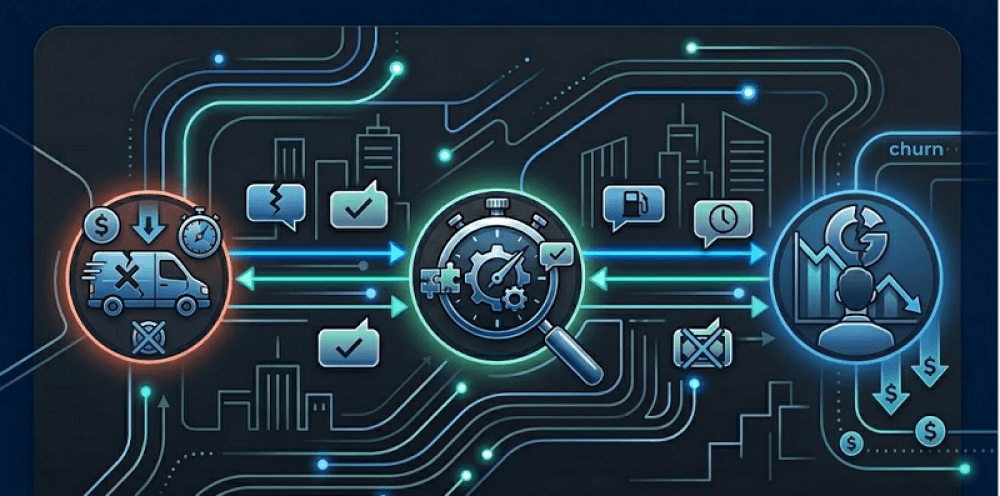
When a delivery fails, the financial impact doesn't fall in one line item. It spreads across four categories that almost never get consolidated into a single number:
1. Direct redelivery cost The vehicle goes out again. The driver's time is consumed again. Fuel is burned again. And the customer's delivery window — in many B2B scenarios — may no longer be available.
2. Internal management cost Someone on your operations team has to reach the customer, reschedule, update the system, and re-brief the driver. Depending on your operation's complexity, that's 15 to 45 minutes of administrative labor per exception — for every single failed stop.
3. Opportunity cost A driver returning with undelivered product is a driver who couldn't complete an additional productive stop. Last-mile logistics accounts for approximately 53% of total shipping costs in B2C supply chains — every unproductive mile pushes that ratio higher.
4. Customer retention cost
This one is the hardest to quantify and the most expensive in the long run. 43% of buyers will switch providers after one or two poor delivery experiences. In B2B, where contracts are long-term but patience is finite, a pattern of failed deliveries isn't an operational issue — it's a churn driver.
Running the Numbers: What This Actually Looks Like
Let's make this concrete. Assume your operation runs 400 deliveries per day with a 7% failure rate — a conservative estimate for non-optimized operations.
That's 28 failed deliveries daily. If each one costs an average of $9 in direct expenses (redelivery fuel + driver time + internal rescheduling), you're looking at $252 per day that generates zero revenue.
Over a 22-day working month: $5,544. Over a full year: over $66,000 absorbed by your operation with nothing to show for it.
And that's before accounting for any lost accounts.
The math will look different for your specific operation — your cost per stop, your vehicle type, your team size all factor in. But the mechanism is identical: failed deliveries are not a customer service problem. They are a profitability problem hiding in plain sight.
Want to know your number? Delego's team can help you calculate the real financial impact of your current failure rate in a no-cost diagnostic session. Request your demo
What's Actually Causing Failed Deliveries
Before jumping to solutions, it's worth being direct about causes: most failed deliveries are not random events. They are predictable outcomes of process gaps that compound over time.
- Inaccurate or unverified address data Geocoding failures are a significant driver of delivery exceptions, particularly for operations serving dense urban markets like Houston and Miami. A driver searching for an address that doesn't resolve correctly in the system isn't losing time through carelessness — the problem was built into the route before the truck left the yard.
- Time window mismatches B2B customers — retail chains, healthcare facilities, institutional buyers — operate within strict receiving windows. A route planner that doesn't account for those windows at the planning stage will generate avoidable rejections at the destination. The delivery isn't late from the driver's perspective; it's late from the system's perspective because the system didn't plan for it.
- Customer not available at point of delivery In B2C last-mile, this is one of the top causes of first-attempt failure. The good news: it's largely preventable. Customers who receive real-time updates about their delivery and can track their shipment are far more likely to be present when the driver arrives, directly reducing failed attempts.
- Overloaded routes and poor capacity planning Routes with more stops than a driver can realistically complete in a shift — or vehicles carrying the wrong load for their assigned sequence — create a predictable overflow. The result is deliveries that get pushed to the next day, compounding the backlog.
What High-Performing Operations Do Differently
Companies consistently achieving first-attempt delivery rates above 95% aren't doing it with more drivers or bigger fleets. They're solving the problem before the truck leaves the depot.
Three capabilities make the difference:
- Intelligent route planning Building routes that factor in time windows, vehicle capacity, real-world distances, and customer priority at the planning stage — not as an afterthought. Route optimization is one of the most effective methods for managing fleets more efficiently, improving delivery times, and reducing failed deliveries. The technology handles complexity that manual planning cannot.
- Real-time operational visibility Knowing where every driver is, in real time, allows dispatch teams to intervene before a potential failure becomes an actual one. Rerouting around traffic, reallocating stops when a driver runs behind, or flagging a time window conflict before the vehicle arrives — none of this is possible without live visibility.
- Proactive customer communication Automated notifications that tell customers exactly when their delivery will arrive — with a live tracking link — eliminate a significant share of "customer not present" failures and remove the inbound call volume from your customer service team.
How Delego Addresses This From the Ground Up
Delego is a field operations management platform built for mid-to-large companies running complex delivery and service operations. It's not a GPS tracker — it's a system that eliminates the process gaps that generate failed deliveries in the first place.
- AI-powered route optimization: Every route is built considering time windows, vehicle capacity, commercial priorities, and geographic constraints. Drivers depart with routes they can actually complete.
- Intelligent geocoding: Addresses are verified and resolved to precise coordinates before planning begins — removing one of the most common and preventable causes of delivery failure in urban markets.
- Real-time tracking and automated notifications: Customers know when their delivery is arriving. Operations managers know where every vehicle is. When an exception occurs, the system flags it so teams can respond before it escalates.
- Electronic proof of delivery (ePOD): Photo capture, digital signature, and timestamp on every completed delivery. No paper, no disputes, no "we never received that."
The Cost of Doing Nothing Is Also a Number
Many companies delay investment in logistics technology because it feels like an added expense. What they're not calculating is the cost of continuing to operate the way they are.
If your current first-attempt failure rate sits between 5% and 10% — the typical range for non-optimized operations — you're already paying that cost every month. The difference is that you're not getting anything in return.
Reducing your failure rate by even 3 percentage points isn't just an operational win. It's recovered margin, retained customers, and a team that ends each shift having done the job they were sent out to do.
Ready to find out what your operation is leaving on the table? Delego's team can walk you through a no-cost diagnostic to calculate your actual impact. Request your demo