In logistics, we often say that "time is money," yet few companies accurately measure what happens from the moment a vehicle stops until it pulls away again. Nowadays, a route can be geographically perfect, but if the "service time" at each stop is excessive, your operation's profitability will plummet.
Service time is the period a driver spends unloading, validating documents, and handing over the product. If you don't audit these minutes, your intelligent planning algorithms will be working with theoretical data. This is where Delego transforms your operational visibility through driver activity reporting.
The Cost of "Invisible Minutes"
When you plan a route estimating that each delivery will take 5 minutes, but it actually takes 12, a domino effect occurs:
- Accumulated Delays: By the end of the day, the last customer receives their order hours late.
- Lack of Visibility: The hub doesn't know if the delay is due to traffic or specific difficulties at the delivery point.
- Driver Dissatisfaction: The pressure to complete a route that doesn't consider real-world times increases stress and the risk of errors.
How Delego Audits and Optimizes Service Time
Delego.ai enables the measurement of execution at every point through the courier's direct interaction with our SaaS platform:
1. Task-Based Activity Logging
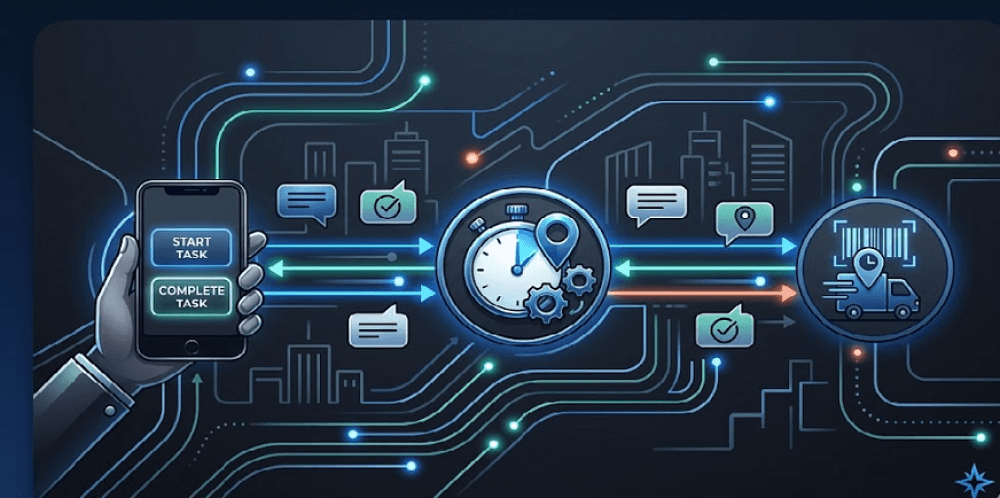
Within the Delego App, the driver has control over their workflow. Upon arriving at a destination, the courier marks "Start Task," notifying the system that the delivery process has begun. Once the task is finished, they change the status to "Completed." This interval between start and finish allows management to know the actual duration of each field interaction.
2. Identifying "Bottlenecks"
Is there a specific customer who always takes 20 minutes to receive an order? Is there a delivery point where the unloading process is slower than usual? Delego’s reports allow you to identify these critical points based on information reported by your drivers. This enables you to adjust time windows or renegotiate delivery conditions based on real field data.
3. Adjusting Based on Real Experience
True efficiency happens when you use this data for planning. If reports indicate that in certain zones or with certain customers, service time is consistently higher, you can adjust the parameters of your future routes. In this way, Delego helps ensure your delivery promises are realistic and achievable.
Benefits of Measuring Service Times
- More Accurate Delivery Promises (ETA): By knowing real unloading times, the system projects more certain arrival times.
- Operational Transparency: Understand if a delay is external (traffic) or internal (delivery process).
- Improved Planning: Ability to balance routes fairly, preventing a driver from being overloaded due to poorly calculated service times.
Conclusion: What Gets Reported, Gets Improved
Last-mile efficiency is won minute by minute. By encouraging the correct use of the App to report the start and end of each task, you gain total control over your business's most valuable metric: your team's time. With Delego, data from the street becomes intelligence for your office.
Want to know how long your deliveries actually take?
. Discover how Delego’s task management can optimize your profitability today